My research interests lie in applied and computational algebraic geometry, with a focus on metric algebraic geometry and algebraic statistics.
Papers in Progress
- A. Haznedar, O. Henriksson, Y. Jiao, and P. N. Jorge. How does the ML degree change when a toric model is linearly transformed? In preparation.
Academic Projects
DresdenDIR - Algebraic Statistics
During the six-week DresdenDIR summer research programme in August–September 2026, I studied the maximum likelihood degree of toric models under linear changes of coordinates, focusing on Veronese and Segre embeddings.
Our research explored the following questions:
- What is the maximum likelihood degree for a generic transformation matrix?
- How does the discriminant describe exceptional transformations?
- How does the maximum likelihood degree vary across the space of matrices?
- Which degrees are attainable? In particular, can we attain degree one and every integer up to the generic degree?
- What changes when we restrict to statistically meaningful transformations, such as stochastic matrices?
I am continuing this research with colleagues from DresdenDIR, and we are currently preparing a research paper.
Master’s Thesis - Polar varieties and Applications
My master’s thesis, Polar Varieties and Applications (University of Copenhagen, 2026), was supervised by Nidhi Kaihnsa. It studies classical and reciprocal polar varieties, their degrees, and their applications to Euclidean and polyhedral distance optimization. It unifies several definitions of polar varieties, it introduces higher order osculating geometry. Defined higher-order polyhedral distance loci using it.
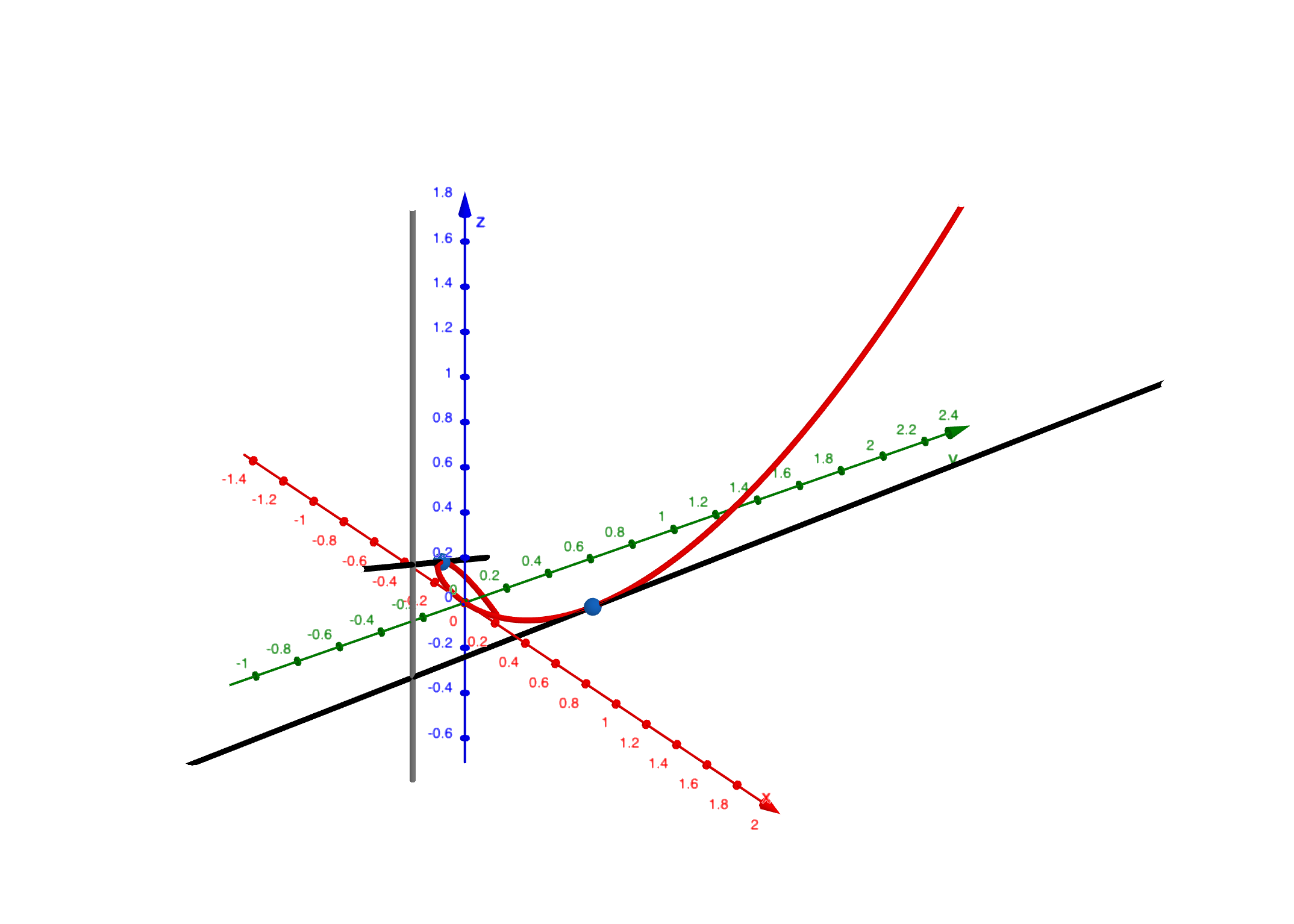
Polar variety of the twisted cubic with respect to line.
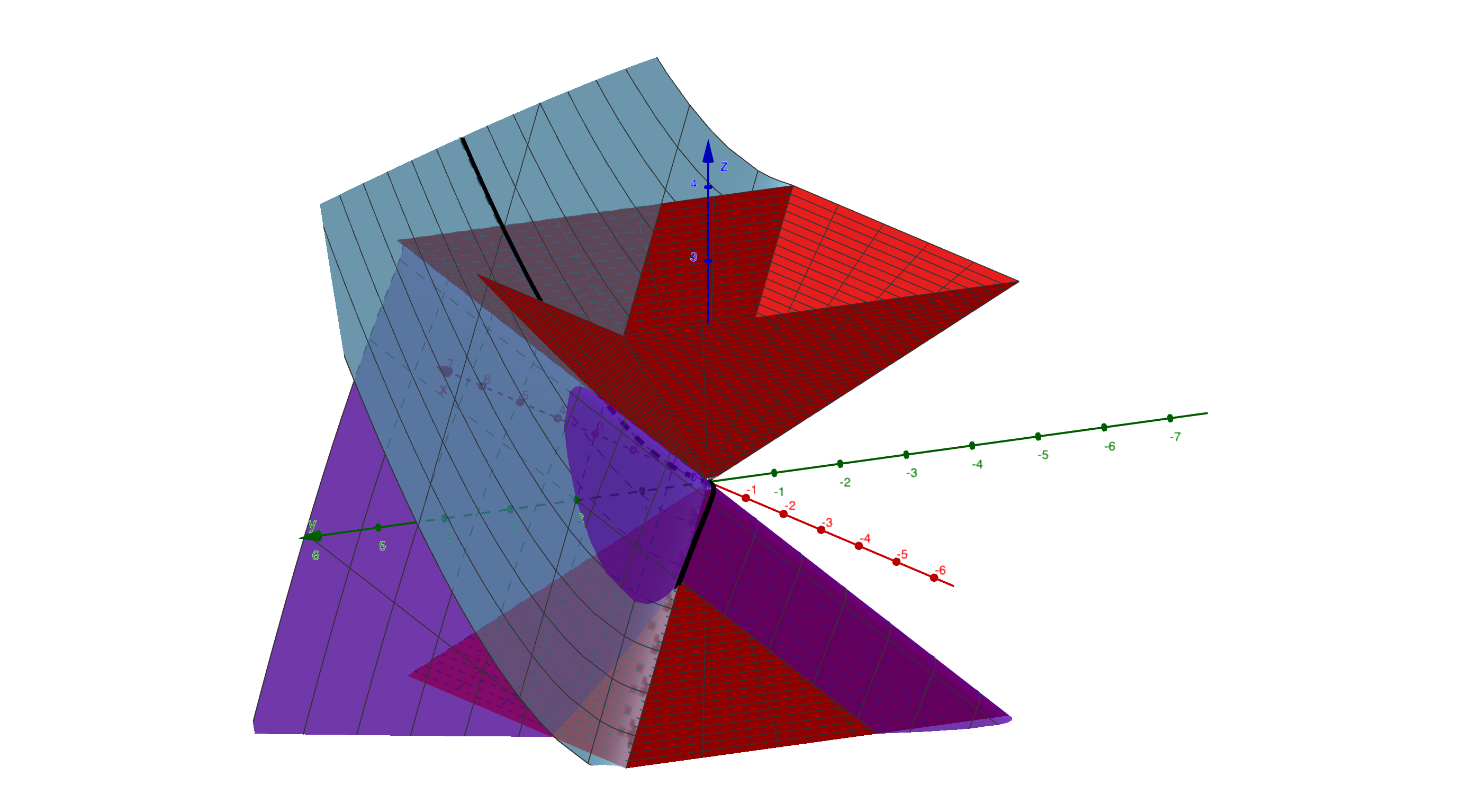
Higher-order polyhedral distance loci for the twisted cubic
Distance Optimization Questions
November 2025–January 2026 · Supervisor: Nidhi Kaihnsa
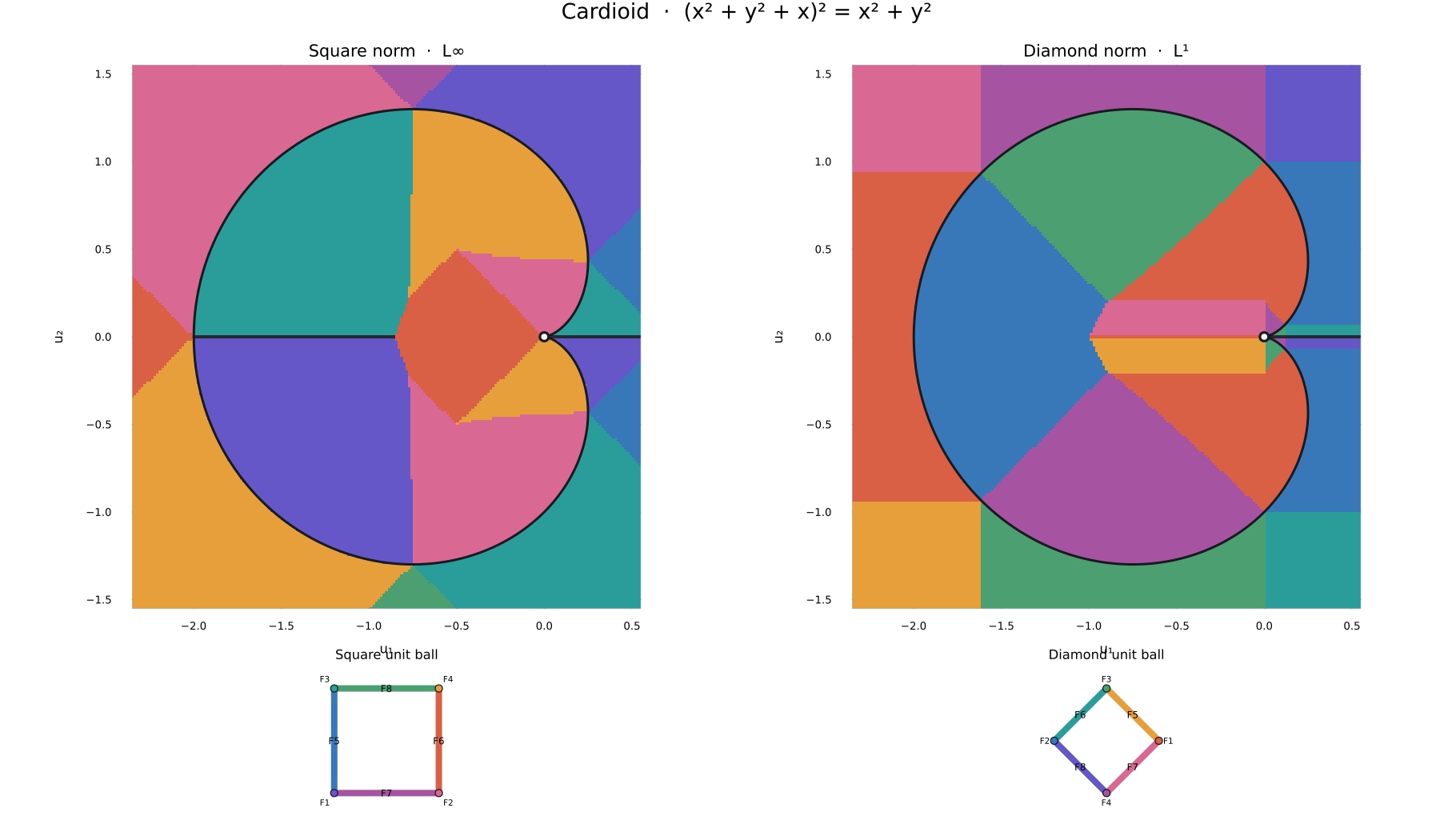
I studied Euclidean and polyhedral distance optimization on real algebraic varieties, through a literature review that built my foundation in metric algebraic geometry. The project connected symbolic computations with numerical methods for finding nearest points on varieties.
I implemented algorithms in Julia using OSCAR and HomotopyContinuation.jl, and studied Voronoi diagrams for the corresponding norms.
Positive solutions of sparse polynomial systems
September–October 2025 · Supervisor: Elisenda Feliu
I studied criteria for the existence and number of positive real solutions of sparse polynomial systems. Using Gale duality, I explored how the structure of a system yields certificates for the existence of a positive solution, and how sign variations give sharp upper bounds for systems supported on circuits.
I implemented results from the literature in OSCAR in Julia to check the criteria on examples. The project brought together real algebraic geometry, combinatorial sign conditions, and computational methods.
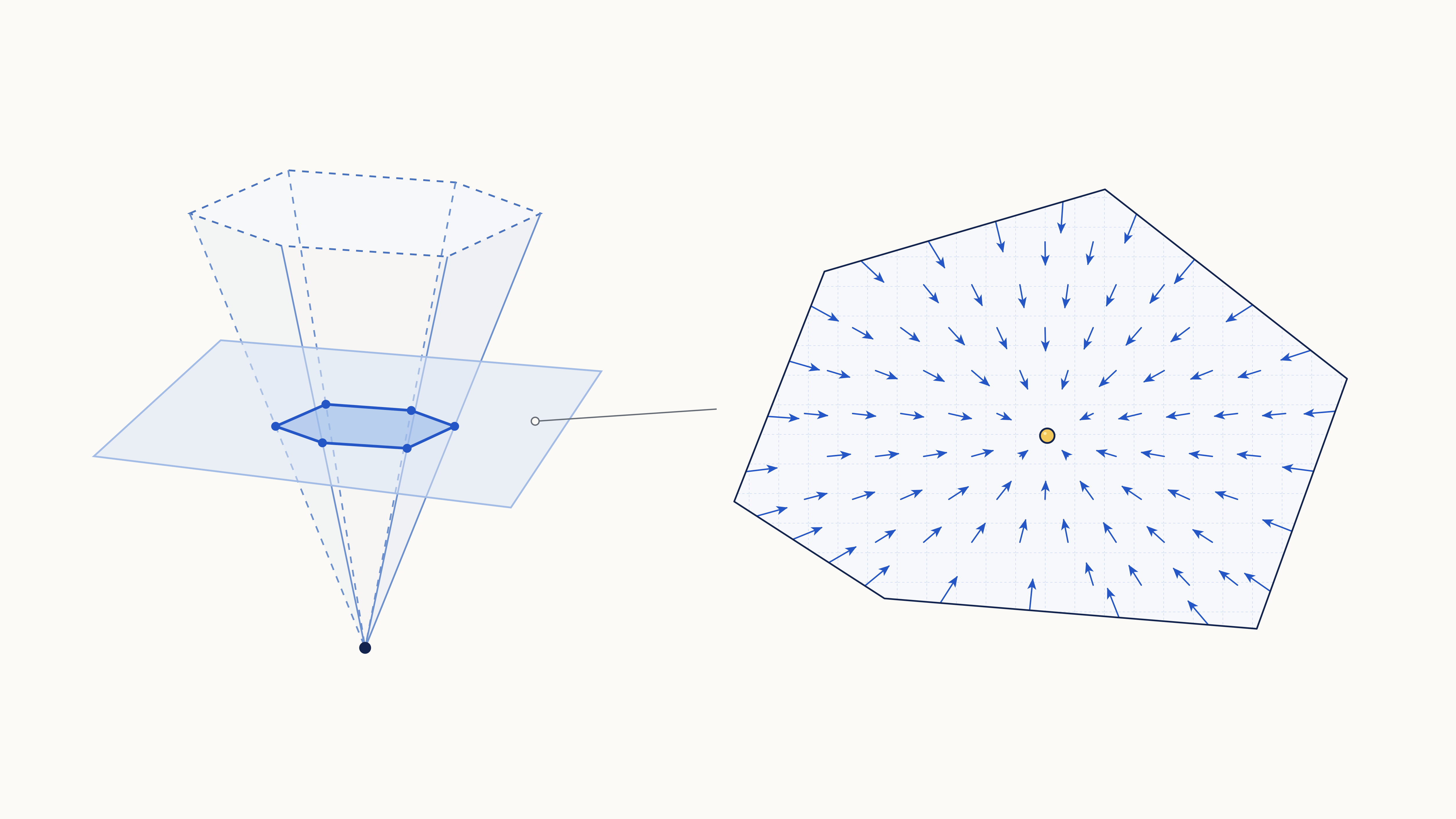
Geometric Combinatorics and Fitness Landscape Model
Image right
Layout column
Geometric combinatorics and polynomial posets, Supervisor: Muhittin Mungan (2021–2023). Linear extensions subject to algebraic constraints, using polyhedral methods and linear programming.
Layout column